
WordPress Login and Dashboard: A Beginner’s Guide

New to WordPress? The first step after installing or setting up a site is learning how to sign in and find your way around the administration area. This guide explains the standard WordPress login addresses, what happens after you sign in, how to use the Dashboard, and why the menus and widgets may look different on different websites.
The examples below use a typical WordPress installation. Your hosting provider, theme, plugins, user role, or a customised login plugin may change parts of the interface.
1. How to open the WordPress login page
For a standard WordPress installation, you can usually reach the login page in either of these ways. Replace example.com with your website’s domain:
- Administration address:
https://example.com/wp-admin/ - Direct login address:
https://example.com/wp-login.php
If you are not signed in, opening /wp-admin/ normally redirects you to the login form. After successful authentication, WordPress takes you to the administration area, subject to your account permissions and any site-specific settings.
For a local development site: an address such as http://localhost/mysite/wp-admin/ works only when WordPress is installed in a local web-server environment under the folder mysite. Do not use localhost for a live website.
2. Sign in to your WordPress website
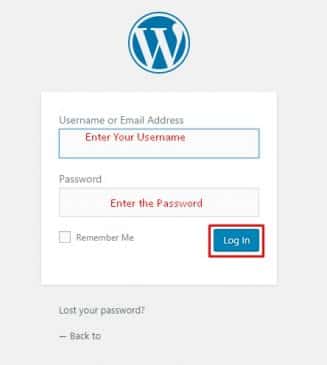
- Open your website’s standard login address or the custom login address supplied by your hosting provider or site administrator.
- Enter the WordPress username or the email address associated with your account.
- Enter your password. Passwords are case-sensitive.
- If the device is private and trusted, you may select Remember Me. Avoid doing this on a shared or public computer.
- Select Log In. If your site uses two-factor authentication, complete that additional verification step too.
If you cannot remember your password, use the Lost your password? link on the login page and follow the email instructions. The reset email must be deliverable to the address associated with your account. If it does not arrive, check spam and contact the site administrator or hosting provider rather than trying unverified database changes.
Some websites use a security plugin or hosting feature to change the default login URL. If the standard addresses show a 404 page, check the custom address configured for your site. Do not assume that every WordPress website uses the same login path.


3. What is the WordPress Dashboard?
The Dashboard is the main landing screen of the WordPress administration area. It gives you an overview of site activity and shortcuts to common management tasks. Depending on your permissions and the software installed on your site, it may show content summaries, recent comments, drafts, news, site-health information and widgets added by plugins or themes.
4. Understand the main areas of the administration screen
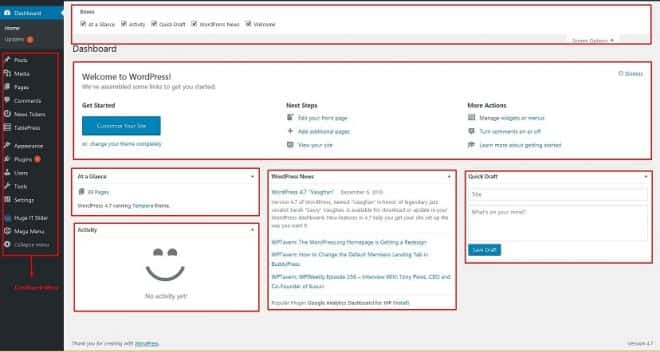
Admin toolbar
The toolbar appears across the top of the administration area. Depending on your role and site configuration, it provides shortcuts such as viewing the website, opening the WordPress information menu, creating content, reviewing comments, checking updates and accessing your profile.
Left-hand navigation menu
The main navigation menu provides access to the sections you are allowed to manage. Common items include:
- Dashboard: the home screen and update information.
- Posts: create, edit and organise blog posts and categories.
- Media: manage images, documents and other uploaded files.
- Pages: manage static pages such as About or Contact.
- Comments: review and moderate visitor comments when comments are enabled.
- Appearance: manage theme-related features. Depending on the active theme, this may include the Site Editor, themes, menus, widgets or Customizer.
- Plugins: manage extensions, if your account has permission to do so.
- Users: manage accounts and profiles, subject to your role.
- Tools and Settings: access additional site-management and configuration options.
You may not see every item. WordPress roles, multisite settings, hosting restrictions, plugins and customisations can all affect which menu options appear. A missing menu item does not necessarily mean the feature is broken.
5. Important Dashboard widgets
Dashboard widgets are information panels displayed on the Dashboard home screen. WordPress includes several core widgets, while plugins and themes may add their own. The exact selection can vary.
At a Glance
This panel summarises site content, such as the number of posts and pages. It can also show information about the active theme and WordPress installation. The links in the panel take you to the relevant management screens.
Activity
The Activity panel can show recently published posts, scheduled posts and recent comments. Where comment moderation is enabled and your account has the necessary capability, you can follow links to review or moderate comments.
Quick Draft
Quick Draft is a small Dashboard form for entering a post title and a short note, then saving the item as a draft. It is useful for capturing an idea quickly. For a complete article, open the full post editor so you can add blocks, images, links, categories and other details.
WordPress Events and News
This widget provides WordPress project news and information about community events. It is different from your own site’s posts and should not be confused with the Activity panel.
Welcome and other panels
A Welcome panel may provide shortcuts for common setup tasks. You may also see Site Health information or widgets supplied by plugins and hosting services. Some panels can be dismissed or hidden, so their absence is not automatically an error.
6. Customise the Dashboard with Screen Options
On the Dashboard screen, the Screen Options panel lets you choose which available widgets are displayed. To use it:
- Open Dashboard → Home.
- Find and open Screen Options, usually near the top of the screen.
- Use the available checkboxes to show or hide supported widgets.
- Close the panel and arrange the visible widgets if the interface allows it.
Screen Options are specific to the administration screen you are viewing. A setting available on the Dashboard may not be available on the Posts or Media screen. Some preferences can also be saved for your user account rather than for every person who uses the website.
7. WordPress user roles and why your Dashboard may look different
WordPress uses roles and capabilities to control what each account can do. The standard roles include Administrator, Editor, Author, Contributor and Subscriber. WordPress Multisite also has a Super Admin role, and plugins can add custom roles.
- Administrator: generally manages most site settings and administration features on a single-site installation.
- Editor: manages and publishes content, including content written by other users.
- Author: writes and publishes their own posts.
- Contributor: writes and manages their own posts but normally cannot publish them.
- Subscriber: has basic reading and profile access.
These are the default role descriptions; custom capabilities and multisite rules can change the actual permissions. Give each user only the access required for their work. If a menu option is missing, ask the site administrator to check the account’s role and capabilities instead of sharing an Administrator login.
8. Basic security practices for your WordPress login
- Use HTTPS on the live website and avoid entering credentials on an unexpected or insecure page.
- Use a long, unique password and store it in a reputable password manager.
- Enable multi-factor authentication where it is available through your site or identity provider.
- Use separate accounts for individual people and assign the least-privileged role that meets their needs.
- Keep WordPress, themes and plugins maintained, and review update notices before applying changes to a production site.
- Maintain a tested backup plan and know how to contact your hosting provider if you are locked out.
- Log out when using a shared computer, and do not save passwords in a public browser profile.
Changing the login URL can be part of a site’s configuration, but it should not replace strong authentication, updates, backups and appropriate user permissions.
9. Common WordPress login and Dashboard problems
The login page does not open
Check that you have entered the correct domain and installation path. If your site uses a custom login URL, use the address configured by the administrator. A security plugin, cache or hosting rule may affect the default login path.
Your username or password is rejected
Check spelling and capitalisation, confirm that you are using the username or email associated with the WordPress account, and use the password-reset link if necessary. If the reset email is not received, ask the administrator or host to check the account and mail delivery.
You can log in but cannot see a menu item
Your account may not have the capability required for that section. Ask an Administrator to review your role and the site’s custom permissions. Plugins and managed hosting can also hide or replace parts of the administration menu.
The Dashboard looks different from a tutorial screenshot
Check the WordPress version, active theme, installed plugins, user role and Screen Options. Old screenshots may show a previous interface. Use current documentation for the version installed on your website.
Where can you check updates and site health?
Use Dashboard → Updates to review available WordPress, theme, plugin and translation updates. Use Tools → Site Health to review configuration checks and technical information. Read update notes and keep a current backup before making significant production changes.
10. Useful WordPress resources and related guides
- WordPress Dashboard screen documentation
- WordPress Administration Screens
- WordPress roles and capabilities
- Troubleshoot WordPress login issues
- Reset your WordPress password
- WordPress Site Health screen
You may also find these RochakSite guides useful:
Frequently asked questions
What is the default WordPress login URL?
For a standard installation, the login form is available at https://example.com/wp-login.php. Visiting https://example.com/wp-admin/ while logged out normally redirects to the login form. A site may use a custom login URL.
Can I log in to WordPress with my email address?
Yes. The standard login form accepts the username or the email address associated with the WordPress user account, along with the account password.
Why do I see fewer options in my WordPress Dashboard?
Dashboard menus and available actions depend on your user role and capabilities. Plugins, themes, hosting providers and multisite settings may also change the interface.
How can I recover a forgotten WordPress password?
Use the Lost your password? link on the login page and follow the reset email. If the email does not arrive or the account cannot be identified, contact the site’s Administrator or hosting provider.
Are the screenshots in this article current?
No. The two original screenshots were uploaded in March 2017 and are retained as historical illustrations. The written instructions describe the standard login paths and current Dashboard concepts; exact labels and layouts can differ between installations.
Conclusion
The WordPress login page gives you access to the administration area, while the Dashboard provides an overview of site activity and shortcuts to the tools available to your account. Once you understand the login addresses, navigation menu, widgets, Screen Options and user roles, it becomes easier to manage a WordPress website confidently. When a screen looks different, check your permissions and installed configuration, then refer to the official documentation for your WordPress version.



Good Work.. Keep it Up. (y)
Thanks……………………….
thanks ……..